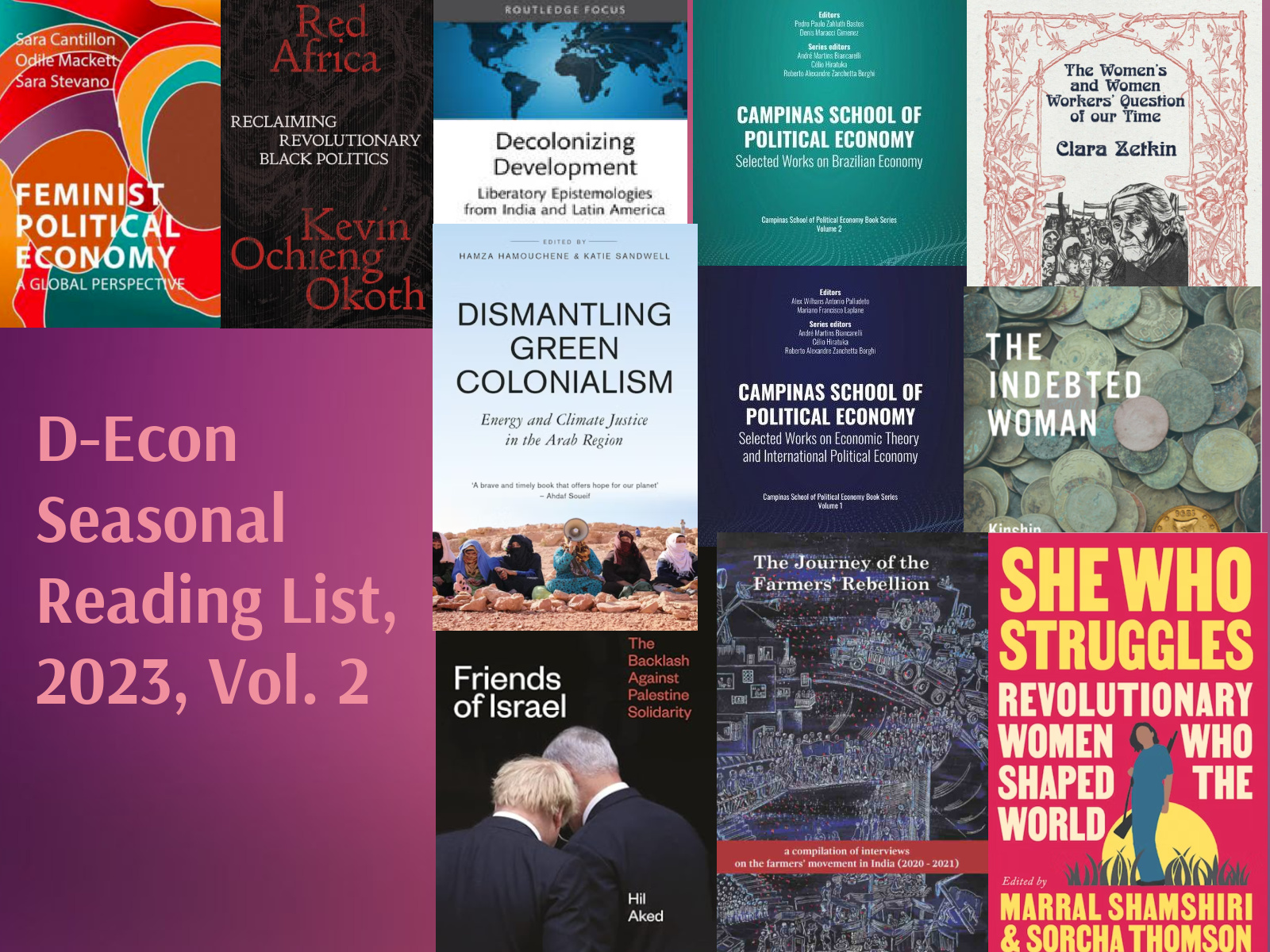
As the year comes to an end, and we head into the holiday season, here’s D-Econ’s second reading list, which has our recommendations of books published in the latter part of 2023 (see part 1 here). These include books you may have missed because of the identity of the author, or their geographical location, or because the topic is not typically considered interesting to those interested in reading about the economy. We include 11 books that cover a range of topics that we think provide a richer understanding of socioeconomic phenomena and are therefore crucial to understanding economics and the world.
Maybe it’s just us, but this year felt like one of those years which had several weeks in which decades happened, with intensifying indebtedness and genocide joining the ongoing climate catastrophe in a weird dystopic bacchanalia. Luckily, authors around the world have written books that can help us understand this convergence of crises, and serve as sources of hope and inspiration. It is no surprise then that we have many books on anti-imperial social, political, and economic movements. Specifically, we have been reading about the backlash against solidarity with the struggle of Palestinian liberation, revolutionary Black politics in Africa, a new translation of the work of legendary socialist Clara Zetkin, women engaged in “transformative, anti-colonial, anti-imperialist, and socialist projects” around the world, and a farmer’s rebellion in India. As economists, we firmly believe that it is impossible to understand the world and consequently the economy without learning from activists who respond to and help in shaping struggles for economic justice, and therefore, these books are a fundamental part of reading about economics.
However, in our heart of hearts, we are a group of nerds. Therefore, we also have been reading about often ignored economic theories and histories of thought. The relatively-more academic books that we include are accessible, and we hope that you can add them to your bookshelf (even if you don’t take them with you to beach or read them as light bedtime reading) and learn about feminist political economy, decolonizing development, and the history of economic thought from one of the foremost centres of economic knowledge in Brazil.
We hope you enjoy these books, and they energize you for the coming year. As always, please let us know if you have any suggestions for our next reading list.
Red Africa: Reclaiming Revolutionary Black Politics
By Kevin Ochieng Okoth

This is an important new book that lays out the history of Black and Marxist revolutionary politics in Africa in a very accessible way. It shows how African anti-colonial struggles have inspired a particular kind of radical politics that has largely been lost in more mainstream approaches to decolonial theory and race. Okoth argues that anti-colonial Marxism and Black radicalism are highly compatible within the anti-imperialist tradition he labels Red Africa. The book not only lays out how the African anti-imperialist traditions contrast with other mainstream approaches to decolonisation and race, but also traces specific revolutionary writers, such as Eduardo Mondlane, Amílcar Cabral, Walter Rodney and Andrée Blouin. Crucially, Okoth also discusses the contemporary relevance of these writers and how it can help us build towards the utopian promise of freedom. Buy the book here.
Decolonizing Development: Liberatory Epistemologies from India and Latin America
By Rahul A. Sirohi, Sonya Surabhi Gupta

This is another short and accessible book that brings complex debates emerging from the Global South to a more general audience. What we particularly liked about this book was the South-South engagement that the authors pursue, as they discuss intellectual discourses from India and Latin America alongside each other and draw parallels between them. This is a rich source of history of thought from the Global South, but the themes certainly remain relevant today: imperialism, sovereignty, development, and classed, racial, and caste inequalities. While some of the central characters of the book will be familiar to critical economists, such as Dadabhai Naoroji and Raul Prebisch, others may be less known, such as José Carlos Mariátegui, Dr. B.R. Ambedkar and Miguel Ángel Asturias Rosales. A central focus of the book is the liberatory paradigms that have emerged from these spaces of the periphery that continue to guide struggles today. Buy the book here.
The Indebted Woman – Kinship, Sexuality, and Capitalism
By Isabelle Guérin, Santosh Kumar, and G. Venkatasubramanian

This book pays attention to indebted women’s role in the composition of modern capitalism. In its own words it “examines how emerging credit markets exploit women in the classic sense of value extraction… connects debt and the very fact of being a woman”. It is important as it expands our understanding of financialization of social reproduction (growth driven by increasing levels of household debt in order to finance everyday activities) by paying attention to women’s role in managing and repaying debt. The authors draw attention to how women’s debt is characterised in terms of access, motivation, and methods of repayment. They then expand on how women shoulder debt management and repayment, and the multitude of challenges associated. Women, and especially those more financially vulnerable, tend to access more precarious forms of loans. The authors argue that the predatory nature of loans creates a direct link between women’s debt and women’s bodies. The authors identify a sexual division of debt with examples such as prostitution, students with ‘sugar daddies’, women taking on surrogacy, with the objective to finance debt. The book explores debt from a range of viewpoints, such as the sexual division of debt, debt work, debt and love, as well as an exploration of what the future holds. The approach is anthropological, using ethnography, statistics and financial diaries in their method. The empirical evidence focuses on Dalit women in India, and considers a wider understanding of the gendered nature of labour of debt. Buy the book here.
Friends of Israel: The Backlash Against Palestine Solidarity
By Hil Aked

This book is of particular relevance today in a moment when Israeli forces have intensified their genocide on the people of Palestine and the amount of misinformation in the media is clouding people’s understanding of what’s going on. It is sensitively and accessibly written and highly informative about the historical and contemporary role British actors – both in government and in civil society – play in supporting Israel’s apartheid state and in repressing acts of resistance from pro-Palestine movements, including Boycott Divestment and Sanctions (BDS). In its analysis, it draws parallels with the similar anti-boycott campaign waged against the apartheid regime in South Africa. As such, the book serves as an important effort to demystify the actors involved in the Zionist movement and provide an objective historical account at a moment when critiques of Zionism and Israel are often dismissed as anti-Semitic conspiracies. You can buy the book here.
For other books that may aid in understanding the ongoing occupation and genocide, see these book lists on Palestine by Decolonize Palestine, Mondoweiss, Middle East Eye, Haymarket Books, Publishers for Palestine, Verso and Pluto Press. We’ve also compiled a short list of Palestine resources ourselves on the D-Econ handle.
The journey of the farmer’s rebellion
Publisher : GroundXero, Notes on the Academy, Workers Unity

The Indian Government enacted the Indian Agricultural Acts (popularly called the Farm Bills) in September 2020, and they were forced to repeal them in December 2021. In the intervening period, India witnessed one of the largest movements of post-colonial India – a rebellion – against the neoliberal capital, who was trying to make inroads into India agriculture by way of these acts, and the movement emerged victorious. This book is a collection of interviews with leaders of farmers union, agricultural and rural worker unions, zameen prapti sangharsh committee, and journalists, economists, political and cultural activists, documenting the various facets of this movement. It is bringing to light the several critical issues, ranging from unattainability of agrarian livelihoods, exploitation of the landless workers, farmer indebtedness, dispossession from agricultural land, and its interaction with dimensions of caste and gender, that plague the agrarian economy in India. This collection, edited by on-the-ground activist organisations, reveal deep insights about the agrarian political economy and neoliberal capitalism in India, and evince the strength of a people’s movement. You can buy the book here.
Feminist Political Economy: A Global Perspective
By Sara Cantillon, Odile Mackett and Sara Stevano

The book employs a political economy approach, which centrally locates the role of power structures at global, national, and regional level, to unpack how intersectional inequalities, particularly gender inequalities, are shaped in spheres of production and reproduction. Covering themes ranging from considering the macro-structural issues to organisation of everyday life, the authors provide a rich understanding of the interplay between gender, class, race, and other social dimensions within the global economic system. This insightful and accessible text contributes to the ongoing discourse on gender and economics, making it an essential read for students, scholars, and anyone interested in the intersection of feminism and political economy on a global scale. You can buy the book here.
The Women’s and Women Workers’ Question of our Time
By Clara Zetkin (translated into english by Ben Lewis)

Translated to English for the first time after 130 years from its first publication, this pamphlet by Clara Zetkin provides an analysis of the oppression of women and grounds it in the historical development of capitalism and social systems. She stresses on the need to align the interests of men and women to build a common struggle against the existing social order and against capital. In doing so, she also asks for a ‘clean break’ from the bourgeois feminist struggles, which can often remain limited to opportunism and translate to pro-capitalist changes. You can buy the book here.
Campinas School of Political Economy
By Alex Wilhans Antonio Palludeto & Mariano Francisco Laplane (Editors Volume 1). Bastos, Pedro Paulo Zahluth & Gimenez, Denis Maracci (Editors Volume 2)

Volume 1 – Selected Works on Economic Theory and International Political Economy
Volume 2 – Selected works on Brazilian economy
For the first time this selection of publications from the Campinas School of Political Economy have been translated from Portuguese to English. Both volumes are open access, providing free insights to key theoretical and empirical perspectives which has previously been elusive. Volume 1 – ‘Selected Works on Economic Theory and International Political Economy’ consists of three parts. The first part consists of political economy contributions written in the period from the mid-1970s to the end of the 1980s. The chapters analyse key economic thinkers such as Marx, Keynes and Kalecki, extending economic understanding of the structure and functioning of capitalism. The second part focuses on works published in the 1990s, exploring investment flows, firms decision-making logic, capitalist globalisation, financialization and dominance. The combined chapters provide insights to how capitalism behaves under financial dominance, and how the increasing wealth and income concentration are directly destructive to incomes and employment. The third and final part concerns money. It takes a start at the dissolution of the Gold Exchange Standard and develops upon how the global economic system has been disproportionately affected by the post-war Dollar Standard. The chapters set out “to identify the problems that marked the history of the international monetary system built in the shadow of the revival of U.S. hegemony” (p. 331). It develops on how this global imbalance has had far-reaching impacts on the global (trade) relationships today. Volume 2 – ‘Selected Works on Brazilian Economy’ provides the reader with a valuable sample of Campinas School of Political Economy work on challenges for Brazilian economic development experienced in the changing capitalist global economy. It contains both classic and more recent contributions from a range of scholars. Overall, the two volumes reflect great contributions to the field of economics, and the translation work and free access makes it a great resource for the discipline. You can find the two volumes here.
She Who Struggles: Revolutionary Women Who Shaped the World
By Marral Shamshiri and Sorcha Thomson

When we think of movements that changed the world, the household names that are associated with those movements are almost always those of men. But what are the roles that the “women’s question”- feminism, sexual and gender politics, women’s liberation etc- and women have played in transformative social and political movements? This important new book answers some of these questions, by featuring the work done by revolutionary women from around the world, including in Cuba, Ghana, Ireland, Palestine, the Philippines, and Kurdistan, among others. Some of the women featured in this volume did not identify themselves as feminist (which Zetkin, in particular, saw as a bourgeois and elite project), but as socialist, communist, and anti-imperial. Written in the tradition of “history-from-below”, this book challenges the double blind spot that obscures women in histories of communism and communism in the histories of women’s movements. The women in this volume are inspiring and their stories can provide, as the editors put it, “new paths for today’s activism.”
Dismantling Green Colonialism: Energy and Climate Justice in the Arab Region
By Hamza Hamouchene and Katie Sandwell

This book is motivated by two key stylized facts: first, the past decade has made it evident that the unfolding global environmental crisis is disproportionately affecting marginalized groups of people in vulnerable ecosystems all over the world. Second, much of this crisis is inextricably linked to the continued extraction and burning of fossil fuels. The choice to continue burning fossil fuels is one that is driven not only by executives of multinational corporations and the national ruling classes in countries in the Arab region, specifically those in which extraction and sale of fossil fuels form a significant part of their domestic economy. Therefore, the survival of humanity is contingent on a transition away from fossil fuels and leaving them in the ground. But whose interest will this energy transition serve, and who will be expected to bear the cost of the climate and energy crisis? This books addresses these questions by examining this energy transition in MENA countries through the work of scholars from the region. This edited volume is unique in that respect, and unique in its focus on a just and democratic transition. A must read for everyone who is concerned with the impacts of decarbonization globally.
This list was compiled by Alex Arntsen, Devika Dutt, Surbhi Kesar, and Ingrid Kvangraven